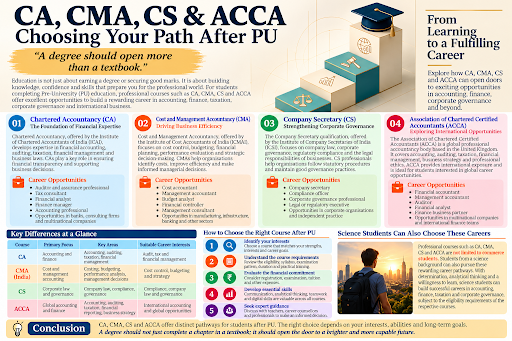
Education is not just about earning a degree or securing good marks. It is about building knowledge, confidence and skills that prepare students for the professional world. For students completing Pre-University (PU) education, professional courses such as CA, CMA, CS and ACCA offer opportunities to build rewarding careers in accounting, finance, taxation, corporate governance and international business.
Each qualification has a distinct focus. Understanding the differences can help students choose a pathway that matches their interests, strengths and long-term goals.
1. Chartered Accountancy (CA): The Foundation of Financial Expertise
Chartered Accountancy, offered by the Institute of Chartered Accountants of India (ICAI), develops expertise in financial accounting, auditing, taxation, financial management and business laws. Chartered Accountants play an important role in ensuring financial transparency and supporting business decisions.
Career opportunities: Auditor and assurance professional, tax consultant, financial analyst, finance manager, accounting professional, and roles in banks, consulting firms and multinational companies.
2. Cost and Management Accountancy (CMA): Driving Business Efficiency
In India, the CMA qualification is offered by the Institute of Cost Accountants of India (ICMAI). It focuses on cost control, budgeting, financial planning, performance evaluation and strategic decision-making. CMAs help organisations identify costs, improve efficiency and make informed managerial decisions.
Career opportunities: Cost accountant, management accountant, budget analyst, financial controller, management consultant, and opportunities in manufacturing, infrastructure, banking and other sectors.
3. Company Secretary (CS): Strengthening Corporate Governance
The Company Secretary qualification, offered by the Institute of Company Secretaries of India (ICSI), focuses on company law, corporate governance, regulatory compliance and the legal responsibilities of businesses. CS professionals help organisations follow statutory procedures, maintain corporate records and uphold good governance practices.
Career opportunities: Company secretary, compliance officer, corporate governance professional, legal or regulatory executive, and opportunities in corporate organisations or eligible independent practice.
4. Association of Chartered Certified Accountants (ACCA): Exploring International Opportunities
The Association of Chartered Certified Accountants (ACCA) is a global professional accountancy body based in the United Kingdom. Its qualification covers accounting, auditing, taxation, financial management, business strategy and professional ethics. It can be relevant for students interested in international accounting and global career opportunities.
Career opportunities: Financial accountant, management accountant, auditor, financial analyst, finance business partner, and roles in multinational companies and international finance teams.
Students should check current entry requirements, examinations, practical experience requirements, exemptions, membership conditions and costs before enrolling.
Key Differences at a Glance
Course | Primary focus | Key areas | Suitable career interests |
CA | Accounting and finance | Accounting, auditing, taxation and financial management | Audit, tax and financial management |
CMA (India) | Cost and management accounting | Costing, budgeting, performance analysis and managerial decisions | Cost control, budgeting and strategy |
CS | Corporate law and governance | Company law, compliance and governance | Compliance, company law and governance |
ACCA | Global accounting and finance | Accounting, auditing, taxation, financial reporting and business strategy | International accounting and global opportunities |
How to Choose the Right Course After PU
- Identify your interests: Choose a course that matches your strengths, career goals and subjects you enjoy.
- Understand the requirements: Review eligibility, syllabus, examination pattern, duration and practical training requirements.
- Evaluate the financial commitment: Consider registration, examination, tuition and other expenses.
- Develop essential skills: Communication, analytical thinking, teamwork, digital skills and problem-solving are valuable across all courses.
- Seek expert guidance: Discuss your options with teachers, career counsellors, qualified professionals and current students.
Beyond Qualifications: Building a Successful Future
A professional qualification provides specialised knowledge, but success also depends on practical skills, industry exposure and professional behaviour. Internships, case studies, digital tools, presentations and real-world learning experiences can help students apply theoretical concepts and build confidence for the workplace.
Employers value communication, teamwork, adaptability, ethical conduct and a willingness to keep learning. Colleges can support students through career guidance, industry interactions and skill-development programmes.
Science Students Can Also Choose These Careers
Professional courses such as CA, CMA, CS and ACCA are not limited to commerce students. Students from a science background can also explore these career pathways, subject to the eligibility requirements of the respective courses.
With determination, analytical thinking and a willingness to learn, science students can build careers in accounting, finance, taxation and corporate governance. Your PU stream does not have to define your future—your interests, aspirations and commitment can help shape the career you choose.
Conclusion
CA, CMA, CS and ACCA offer distinct pathways for students after PU. The right choice depends on individual interests, abilities and long-term goals. With informed decisions, consistent effort and practical exposure, students can turn their education into a rewarding professional journey.

Manikanta B
Commerce Educator
CMR NPU HRBR
About the Author :
“Manikanta B is a passionate Commerce Educator with eight years of teaching experience, specialising in Commerce and Accountancy for Pre-University students. His teaching experience also extends to professional-course subjects such as Income Tax, Financial Management and Accounting. He believes in making complex concepts simple, relatable and engaging by connecting classroom learning with real-world applications. With a keen interest in Accountancy, Taxation and Financial Management, he strives to help students develop a strong conceptual foundation and a practical understanding of the subject. Through his blog, he hopes to share valuable insights, simplify challenging topics and guide students in exploring career opportunities in Commerce. His goal is to inspire young learners to look beyond textbooks and discover the many possibilities that the world of Commerce has to offer”